inside sources print logo
Get up-to-date news in your inbox

Dem Senator Uses Tax Hearing to Rant About Healthcare
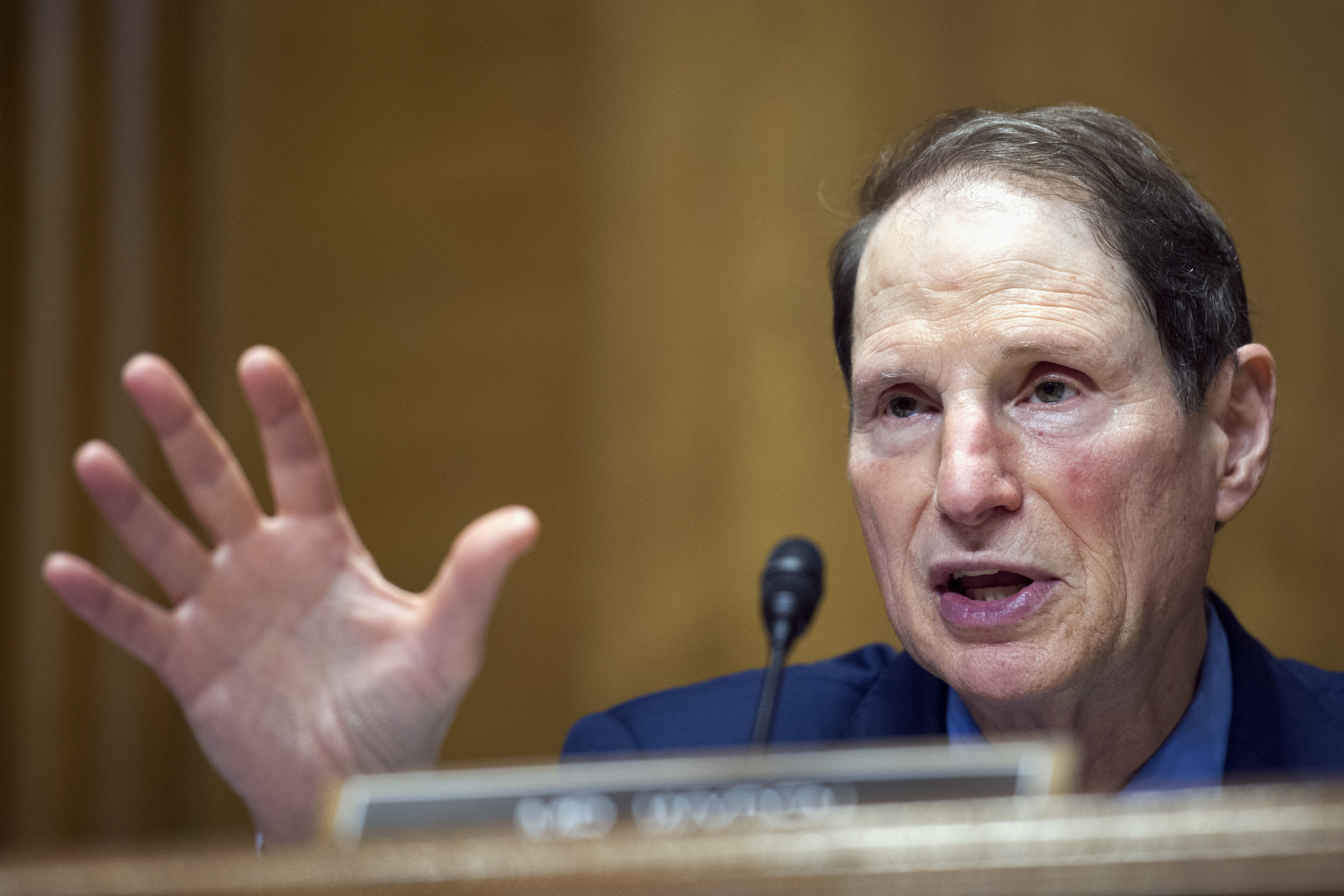
Democratic Sen. Ron Wyden took the opportunity to show his disapproval for a new healthcare bill Tuesday during a hearing intended to discuss tax reform.

The Senate Finance Committee convened the hearing to discuss ways to improve the tax code. Republicans have made tax reform one of their top priorities since the election. Committee Chairman Orrin Hatch noted that the goal is to boost jobs with good wages by reforming business provisions within the tax system.

“During this morning hearings, we’ll be discussing ways to improve the business provisions of the U.S. tax code with an eye towards creating jobs that boost wages for American workers,” Hatch, a Republican, said in his opening remarks. “This hearing is part of an ongoing effort following years of tax hearings.”

Wyden, who serves as the ranking member, decided to take a different approach during the hearing. He instead argued his colleagues on the right are trying to unilaterally push a healthcare bill despite its disastrous consequences. Republican Sens. Lindsey Graham, Bill Cassidy, Dean Heller, and Ron Johnson introduced the bill Sept. 13.

“Last night the majority announced, without consulting the minority, that the finance committee will be holding a hearing on the Graham-Cassidy healthcare bill,” Wyden said. “I think this is an abomination. It is an abomination of the process, it’s an abomination of the of the substance, and it’s abomination of the history of this storied committee.”

The healthcare bill is just the latest attempt to repeal and replace the Affordable Care Act. Republicans failed to replace the bill, repeal it without a replacement, or even cut some provisions with a skinny repeal. Wyden believes the latest attempt could have severe repercussions for millions of people.

“First of all, this bill is a subscription for suffering and disastrous consequences for millions of people,” Wyden said. “Second the budget office informed the Congress that it will be several weeks, at the very least, before it can provide real estimates for the bill. So this means the majority is going to charge ahead with a radical and destructive transformation of America’s healthcare with the American people in the dark.”

Wyden did express that his remarks aren’t meant as an attack against Hatch. Wyden highlighted their bipartisan work and his admiration for the chairman. But he felt compelled to speak out against what he saw as a real threat to the health and well-being of people.

“This bill is going to be a few roll call votes away from the president’s desk, yet Republicans don’t have answers to some of the key gut questions,” Wyden said. “What’s going to happen to premiums for the American people? What is going to happen to their coverage?”

Former President Barack Obama made his healthcare law his signature piece of legislation. Republicans have made repealing Obamacare their main rallying point through his presidency. They have argued the law has caused premiums to skyrocket, significant coverage gaps, and a reduction in insurance options.

“The proposition that a bill this destructive, this far-reaching, can swing through the Senate Finance Committee for a single hearing on a Monday morning, hit the Senate floor a day or two later, makes a mockery of the legislative process that Sen. [John] McCain so elegantly urged us to return to,” Wyden said.

Wyden ended his remarks by talking briefly about some concerns he had with the upcoming tax reform bill. He urged his colleagues on the right to avoid provisions that could be manipulated and turned into loopholes by big corporations, like making it easier to become a pass-through business, which is reserved for smaller employers.

“A hearing will allow members on both sides to dive deeper into the policy, and gain a better understanding of what the proposal is intended to achieve,” Hatch responded afterward. “But even though their requests have been heard, and a hearing is on the schedule, some members are still unsatisfied. I’m not sure what else we can do on this matter to address every complaint. For today, our hearing is on business tax reform.”

Republicans have been building the foundation to mount their push for tax reform over the last year. House Speaker Paul Ryan and Rep. Kevin Brady introduced a blueprint last year which detailed their policy goals. President Donald Trump released a summary plan which highlighted many of the same provisions April 26.

Republicans have been consistent with the general direction they hope to take tax reform. They hope to lower individual and business rates while also simplifying the tax code. They have had some disagreements over specific provisions like the border adjustment tax, which has likely been dropped.

The Congressional Budget Office (CBO) found in an analysis that many other developed countries have been moving towards a more competitive tax system for over a decade. The United States, in contrast, has done little to its tax code to stay competitive since the last time the tax system was reformed in a fundamental way in 1986.

The Business Roundtable found in a survey that business owners would begin investing more back into their companies and employees if the tax system was reformed successfully. National Taxpayers Union Foundation found in a 2015 study that the economy loses $233.8 billion annually from hours spent doing taxes.


Follow Connor on Twitter

Senate Bill Looks to Empower Workers by Restricting Unions

Senate Republicans have introduced a bill Thursday that would put restrictions on unions in the hope it will empower workers.

The Employee Rights Act would primarily change union elections and how dues payments can be taken. Republicans and other supporters argue the bill would enhance worker rights when it comes to whether they want to unionize. Those opposed argue the provisions are an underhanded attempt to hurt unions.

Sen. Orrin Hatch, R-Utah, introduced the measure alongside a group of other Republicans. The senator is a member on the Senate Health, Education, Labor and Pensions (HELP) committee where he used to serve as the chairman. Current Chairman Lamar Alexander joined him in introducing the measure.

“Anyone whose real concern is preserving the rights of individual workers should support the Employee Rights Act,” Hatch said in a statement provided to InsideSources. “This comprehensive workers’ rights bill does not include a single provision that empowers employers at the expense of unions. The only parties whose position will be improved by this legislation are employees.”

The bill would require secret ballot elections, protect personal information during unionizing drives, and require unions to undergo recertification votes. An employee could have his or her personal information and vote kept secret from the union. It also requires unions to get permission before using dues for political purposes.

House Republicans introduced their version of the bill May 25. Both congressional chambers must eventually agree to the same language before it can be passed onto the president for approval. Health and Human Services Secretary Tom Price originally attempted to enact the policy in 2015 when he was still in Congress.

Labor unions are not currently required to get permission when they use member dues for political purposes. Union members can choose to opt-out and become a fee paying member instead. That fee can only cover the cost of representing that worker. The bill would flip that and require the union to get permission first.

Secret ballot elections are intended to limit intimidation and coercion by making all votes anonymous. Unions can currently use a method called card check to bypass secret ballots. Unions instead collect signatures that they can use to pressure employers into accepting them. It’s an unregulated process that potentially opens the door to fraud.

Americans for Prosperity issued a coalition letter alongside other conservative groups July 13 in support of the measure. The letter argued that the policy would allow workers an unencumbered opportunity to make their voice heard on whether they wish to belong to a union. It would ensure unions remain accountable to workers.

The measure would also require unions to win a reauthorization vote once half of the original unionized employees have left. The Heritage Foundation, a conservative research nonprofit, found in a 2016 report that just six percent of unionized workers nationwide actually voted for their union.

Labor unions and other critics argue the policy merely serves as an underhanded way to hurt unions. The Communications Workers of America (CWA) expressed several concerns during a congressional hearing June 14. The union primarily notes the bill would hurt workers by limiting the ability of their union to protect them.

“ERA prohibits employers from voluntarily recognizing a union based on a showing of majority support from the employees,” CWA general counsel Guerino Calemine said at the hearing. “It is the preferred way of organizing because it minimizes the strife of the election process, and voluntary recognition usually comes by way of agreements that also require the employer to be neutral or provide the union with actual access to the voters in the workplace.”

The Economic Policy Institute, a progressive research nonprofit, argued the policy would make it unreasonably difficult for unions to win elections by putting too many requirements on them. It adds the measure rigs union elections against labor organizations.

“A proposal that would subvert democracy and stifle working people’s voices” is how Texas AFL-CIO President John Patrick described the bill in March 2016. “The Employee Rights Act would require working people who want to form a union to obtain not just a majority of those who vote in a union election, but a majority of all possible voters, whether they vote or not.”

House Republicans introduced another bill Feb. 1 aimed at making union dues and fees optional for all workers. President Donald Trump has briefly mentioned his support for right-to-work policies. The U.S. Supreme Court might also take up a case that could potentially end mandatory union dues for all public workers.

Follow Connor on Twitter

Email Privacy Reform Bill Only Solves Half the Problem

Congress is again teeing up a bill to reform a thirty-year-old law giving law enforcement warrantless access to Americans’ stored emails, but advancing the case for reform could be problematic without another pending bill to give investigators other means of accessing such data.

The Electronic Communications Privacy Modernization Act, introduced by a bipartisan pair of senators Tuesday, would require law enforcement to obtain a warrant before accessing cloud-stored electronic communications and geolocation information. Republican Sen. Mike Lee of Utah and Democratic Sen. Patrick Leahy of Vermont rewrote the bill, first introduced last term, to update the 1986 Electronic Communications Privacy Act (ECPA).

ECPA currently gives law enforcement access to American emails 180 days old. The law is at the center of an ongoing legal battle between Microsoft and the Justice Department that began in 2014, when the government ordered the Redmond-based tech giant to turn over emails belonging to an Irish national stored on a server in Ireland.

Microsoft argued DOJ has no authority to compel the Windows maker to turn over data stored on another country’s sovereign soil, and that DOJ must request the emails from the foreign government in question. The government countered that as a company based in the U.S., Microsoft is obligated to adhere to the law, regardless of the physical location of the server itself.

The government eventually lost the case (though they’ve recently sought an appeal to the Supreme Court), and unintentionally ignited a legal debate that will likely result in loss of the Reagan-era law altogether. The House of Representatives unanimously passed ECPA reform last year, and the Senate version only stalled after opposition from agencies like the FTC and SEC, along with amendments from Republicans that, in some cases, sought to expand the FBI’s warrantless subpoena power.

Now the bill is back with new provisions protecting location data, giving law enforcement quick access in emergency situations and compelling agencies to provide notice within 10 days of accessing communications or location data. It’s already received endorsements from left-leaning groups like the ACLU and center-right think tanks including TechFreedom.

“While the House bill left out geolocation protection and notice requirements in anticipation of Senate resistance, today’s bill restores both of those critical reforms,” TechFreedom President Berin Szoka said. “There’s no better or easier way for Congress and the Administration to secure a win for privacy and technology than passing this bill into law.”

But the bill doesn’t provide a clear path for law enforcement to access data stored abroad. Another bipartisan group of senators is tackling that issue in legislation dubbed International Communications Privacy Act (ICPA), also introduced last Congress by Republican Sens. Orrin Hatch of Utah, Dean Heller of Nevada, and Democratic Sen. Chris Coons of Delaware.

ICPA would give law enforcement the means to obtain data on U.S. citizens from U.S. companies — regardless of where the data is physically stored — with the use of a warrant. It also lets U.S. law enforcement seek data belonging to foreign nationals in places where cooperation agreements exist. Additionally, the bill updates and streamlines the mutual legal assistance treaty (MLAT) process, which facilitates cooperation between countries for the exchange of data like that sought by the government in the Microsoft case.

Critics of DOJ’s position in the case say it not only opens the door to violate foreign nationals’ privacy and sovereignty, but leaves the door open for other countries to demand similar data on their citizens stored by U.S. companies.

The European Union is less than a year away from implementing the General Data Protection Regulation, which would strengthen data privacy protections for EU citizens and make it illegal for a company to bring customer data from Europe into the U.S. in response to a U.S. search warrant. That means without ICPA, U.S. law enforcement will have even fewer means of going after data stored in Europe.

Google and Microsoft both support the bill.

“It’s time to lay a new foundation and establish a new legal framework for the cloud,” Kent Walker, senior vice president and general counsel at Google, said in June.

Walker said the current “untenable” framework leaves companies like Google with the choice of violating another country’s laws or its own, and that the U.S. should embrace the “broad set of agreement on basic principles” included in ICPA.

Microsoft President Brad Smith told Congress in May that if it doesn’t act, the status quo will “leave us all hostage to a law that was passed 31 years that hinders law enforcement, undermines privacy rights, and frankly puts tension between countries.” Smith added he and his company have been “broadly supportive” of ICPA’s requirement of U.S. search warrants for digital data.

Follow Giuseppe on Twitter

Subscribe for the Latest From InsideSources Every Morning